
Protecting Standards in the Telecare (TEC) Industry
Protecting Standards in the Technology Enabled Care Industry As the technology enabled care (TEC) industry grows, it plays an increasingly important role in helping people
Chiptech are committed to supporting our in-market partners to get the best out of the current solutions available, while continuing to develop real world solutions that fill the deficits appearing in aged care to the community.
The 65+ population in Aotearoa, New Zealand, is predicted to increase significantly in the next decade or so, topping one million Kiwis. By 2030, it is expected that 19–21% of New Zealanders will be aged 65 years and over, compared with 16% in 2020.1 This has implications on housing, employment, health, financial capability, and social issues. The pressure on these sectors are further exacerbated by a “severely understaffed aged care sector [that] is no longer merely a possibility, but a clear and present danger affecting our elderly population.” 2
“While our aging population in New Zealand is increasing, we are also seeing changes in the way care is being accessed. The biggest trend is that older New Zealanders are choosing to wait longer to access formal care, which means by the time they arrive at a facility their stay will be shorter, but their need for expert care is more acute.” 2
Aged Care Association president Simon Wallace said the workforce was short about 1,000 registered nurses and demand for aged residential care was forecast to increase by an estimated 15,000 beds by 2030.
Unfortunately, Australia’s elderly are facing a dire proposition. It is projected that the number of Australians aged 85 years and over will increase from 515,700 in 2018–19 (2.0% of the Australian population) to more than 1.5 million by 2058 (3.7% of the population). 3
The number of people aged 65 years and over is also projected to nearly double, from 3.8 million people in 2017 to between 6.4 million and 6.7 million people in 2042. 4
Findings from the Australian Royal Commission on Aged Care state that “Aged care services are not generally geared towards people’s enablement and do not maximise the maintenance and improvement of people’s health. The current system does not sufficiently recognise the importance of proactively supporting older people’s social and emotional wellbeing.”
“Australia’s aged care system is understaffed, the workforce underpaid and undertrained. The aged care system is well behind other sectors in the use and application of technology and has no clear information and communications technology strategy. This mix of factors has resulted in an aged care sector that is behind the research, innovation and technological curves.”
With these looming deficits in resources, funding, and people power, technology is being looked at as a way to solve some of the complex challenges in improving patient centred care to older individuals in the community. To this end Chiptech continues to work with our customers and industry partners to research, design and find innovative way to provide technology-based solutions to keep end users safe, well, and active members of the community.
At Home:
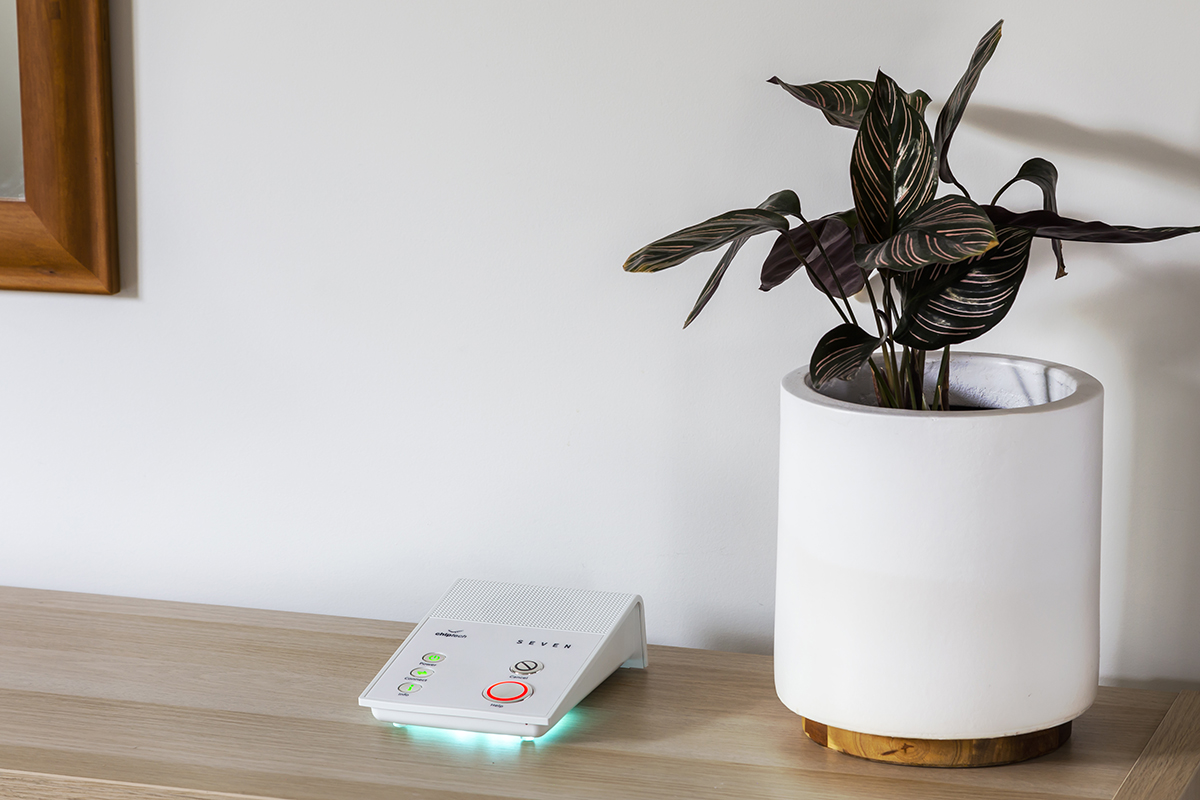
SEVEN is the 7th generation of in-home base units designed by Chiptech as a platform to deliver not only safe communication in the event of an emergency, but to act as a care communication platform for enhanced monitoring and service delivery. Current features on SEVEN include customisable timed daily reminders for taking medication, eating, or going to bed. There is a daily check function, where a user is prompted to check in with their service provider to acknowledge they are Ok. SEVEN has the ability to announce pre-recorded voice notifications, from friendly to critical, such as a caregiver will be there soon, or an evacuation notice. All user interactions with these features can be monitored and actioned by a service provider using an agreed-upon care plan. Additional peripherals can be paired with SEVEN to provide automated alerts for the occurrence of a fall, wandering from home, or the presence of fire or gas in the house.
Chiptech continues to expand the range of features SEVEN offers, and peripherals that can connect to SEVEN, therefore expanding the services able to be provided to end users.
Out and About:
Chiptech’s GO 4G is the latest mPERS offering that provides the user with safety both at home and away with connection to assistance when required, at the press of a button. With automated fall detection this provides an added layer of safety and encourages users to go beyond the boundaries of their home, engage with the community and stay active.
As with all person centred care, the success of technology implementation is based not only on the ease of use, but also the quality of the wrap around service that accompanies the product. Chiptech is committed to supporting our in-market partners to get the best out of the current solutions available, while continuing to develop real world solutions that fill the deficits appearing in aged care in the community. New developments from Chiptech focus on getting the right resources, to the right users, at the right time. Underpinning these new innovations is a comprehensive trail of what has happened leading up to an event and afterwards. Technology enabled care is expanding and becoming more important in delivering quality aged care services to the community.
Want to know more
If you want to learn more about current product offerings or our future solutions roadmap, please contact support@chiptech.co.nz

Protecting Standards in the Technology Enabled Care Industry As the technology enabled care (TEC) industry grows, it plays an increasingly important role in helping people

Summer Safety for Seniors: How to Protect Loved Ones from Heat Risks Summer across Australia and New Zealand is a season we all look forward

Aged care at a turning point: why technology-enabled care must sit at the heart of New Zealand’s reform by: Abby Moore, CEO, Chiptech Coming out
We use the following cookies on this website to make sure we give you the best user experience:
Necessary Cookies: These cookies are necessary to enable certain features of our websites to operate. These cookies may be blocked or disabled through your internet browser. If these cookies are blocked or disabled, some functions of our website will not be available to you.
Performance Cookies: We also use third party analytic and optimisation tools, to help us collect feedback, to analyse data from our website, and optimise our services to you.
For more detailed information about the cookies we use, see our Cookie Policy